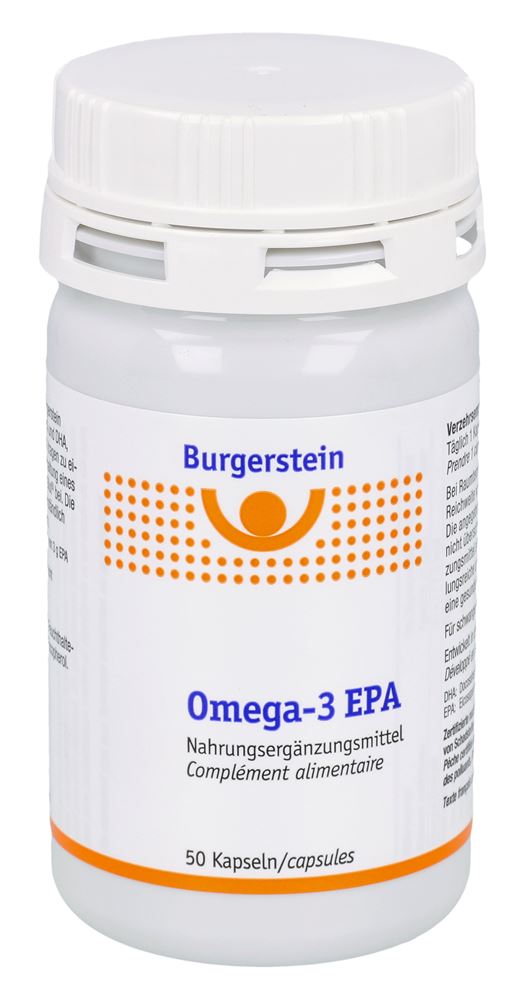
Burgerstein omega-3-epa 100 capsules
Scan to share

Burgerstein omega-3-epa 100 capsules
Les capsules Burgerstein Omega-3 EPA sont une préparation d'huile de poisson de haute qualité qui contient une quantité particulièrement élevée du précieux acide gras oméga-3 EPA. Ce produit contribue à une fonction cardiaque normale ainsi qu'au maintien d'une pression artérielle normale.
Dimensions and measurements
- Pharmacode: 4048943
Les capsules Burgerstein Omega-3 EPA sont une préparation d'huile de poisson de haute qualité qui contient une quantité particulièrement élevée du précieux acide gras oméga-3 EPA. Ce produit contribue à une fonction cardiaque normale ainsi qu'au maintien d'une pression artérielle normale.
Manufacturer description
Text provided by the manufacturer. Source
More EPA – for heart and blood pressure1,2
Burgerstein Omega-3 EPA is a fish oil product with a particularly high content of the valuable omega-3 fatty acid EPA (eicosapentaenoic acid).
- High EPA content: 378 mg per capsule
- Neutral taste: no aftertaste, no fishy burps
- Pleasant to take: capsules that are easy to swallow
- Sustainable fishing: natural fish oil certified by Friend of the Sea
Who is Burgerstein Omega-3 EPA particularly suitable for?
Burgerstein Omega-3 EPA contains high levels of the omega-3 fatty acid EPA and offers an easy way to supplement your diet specifically with EPA.
Burgerstein Omega-3 EPA is particularly suitable for:
-
People with a focus on heart health
Maintaining heart health is of key importance to many people. The omega-3 fatty acids EPA and DHA contribute to normal heart function1 and to the maintenance of normal triglyceride levels in the blood.3
-
People in the second half of their lives
The maintenance of normal blood pressure becomes increasingly important as we grow older. The omega-3 fatty acids EPA and DHA contribute to the maintenance normal blood pressure.2
-
People who eat little or no fish
Oily fish are natural sources of the omega-3 fatty acids EPA and DHA. People who rarely or never eat fish can supplement their EPA intake in a targeted manner. EPA and DHA contribute to normal cardiac function1 and to the maintenance of normal blood pressure.2
2 Positive effect with a daily dose of 3 g of DHA and EPA.
3 Positive effect with a daily dose of 2 g of DHA and EPA.
Take 1 capsule a day with a meal.
Fish oil, coating agent (edible gelatine (fish)), humectant (glycerine), mixed tocopherols, D-alpha-tocopherol
Store at room temperature. Keep out of the reach of young children. Do not exceed the recommended daily dose. Food supplements are not a substitute for a varied and balanced diet and a healthy lifestyle.
Not suitable for pregnant or breastfeeding women.
Developed in Switzerland, manufactured in Germany.
|
Nutritional values |
Per daily portion |
NRV* |
| Energy | 30 kJ / 7,5 kcal | - |
| Fat of which: saturated fatty acids monounsaturated fatty acids polyunsaturated fatty acids of which: omega-3 fatty acids (378 mg EPA and 92 mg DHA) |
0,7 g 14 mg** 28 mg** 651 mg** 564 mg** 470 mg |
- |
| Carbohydrates of which sugars of wihich polyols |
< 0,1 g 0,1 g < 0,1 g |
- - - |
| Dietary fibre | 0,0 g | - |
| Protein | 0,2 g | - |
| Salt | 0,0 g | - |
| Vitamin E | 7,5 mg | 62% |
* NRV = Nutrient reference value
**May vary; natural product
DHA: docosahexaenoic acid
EPA: eicosapentaenoic acid
Why are omega-3 products suitable for people who eat little or no fish?
People who eat little or no fish consume little EPA and DHA in their diet. In addition, our body only produces the two fatty acids in small quantities from alpha-linolenic acid. Targeted supplementation of DHA may therefore be particularly useful for people who eat little or no fish.
Does Burgerstein have other omega-3 products?
Yes. Burgerstein Omega-3 offers the following products:
Burgerstein Omega-3 DHA, with a higher DHA level; Burgerstein Omega-3 EPA, with a higher EPA level and Burgerstein Omega-3 vegan, for people who want to avoid fish oil or follow a vegan diet. There is also a liquid version available with Burgerstein Omega-3 liquid.
What are omega-3 fatty acids?
Omega-3 fatty acids are a group of polyunsaturated fatty acids that are very important for the body. The most important omega-3 fatty acids include alpha-linolenic acid (ALA), eicosapentaenoic acid (EPA) and docosahexaenoic acid (DHA). ALA is mainly found in plant-based foods such as linseed oil and walnuts. EPA and DHA are found in particular in oily marine fish and in certain kinds of algae.
What is the difference between the omega-3 fatty acids DHA and EPA?
DHA (docosahexaenoic acid) and EPA (eicosapentaenoic acid) are polyunsaturated fatty acids that occur naturally primarily in oily marine fish, but also in certain kinds of algae. They perform different tasks in the body.
DHA is particularly important for the brain and the eyes1. Together with DHA, EPA plays an important role in cardiac function. 3
This means that, based on specific requirements, an omega-3 supplement with a higher proportion of DHA or EPA may be useful.
1 Positive effect with a daily intake of 250 mg DHA.3 Positive effect with a daily intake of 250 mg of EPA and DHA combined
Which foods contain omega-3?
Omega-3 fatty acids are found in both animal and plant foods. Oily marine fish such as salmon, herring, mackerel and sardines are particularly good sources of the omega-3 fatty acids EPA and DHA. Plant-based foods such as flaxseed, chia seeds, tree nuts, linseed oil and rapeseed oil contain omega-3 mainly in the form of alpha-linolenic acid (ALA).
What is the difference between fish oil and algae oil?
Fish oil and algae oil differ mainly in their origin – both provide important omega-3 fatty acids.
- Fish oil is extracted from oily fish such as salmon, herring, mackerel and sardines. It typically contains the omega-3 fatty acids EPA and DHA.
- Algae oil is extracted directly from microalgae. Microalgae are particularly rich in the omega-3 fatty acid DHA, but they also provide EPA. Algae oil is a good plant-based alternative to fish oil.
What is the TOTOX value?
The TOTOX (total oxidation) value shows how much an oil has oxidised, i.e. aged. It is mainly used to assess the quality of fish oil and algae oil in omega‑3 products.
A good TOTOX value for fish oil is typically below 10.
The following provides a practical guide (according to GOED – Global Organization for EPA and DHA-Omega-3s):
- 0-10: fresh oil, good
- 10-20: acceptable, but not particularly fresh
- 20-26: close to the maximum admissible industry limit
- over 26: does not meet the GOED quality standard
Burgerstein’s omega-3 products are checked regularly and consistently have very low TOTOX values (clearly <10).
| Pharmacode | |
|---|---|
| Pharmacode | 4048943 |
| SKU | 18000.140.851 |